Friday, February 28, 2014

Things That Happen to me in Russia

I started a "note" on my phone the first week I was here, just to write down random, interesting things that happen to me while I'm in Russia! I use that list kind of like a personal Twitter feed, anytime something about my new life here or culturally peculiar is on my mind, I put it on the list! Today I thought I would share the list with you guys and give you a little taste of what goes on here on a daily basis...

1. In a bookstore I heard an instrumental jazz version of 50 Cent's "In Da Club"

2. Creepily standing close to or following people speaking English becomes a thing...

3. I discovered super delicious, melt-in-your-mouth, absolutely addictive 12 ruble (35 cents) pyshki!


4. I've more than once seen a man walk past a car, take off his gloves, sweep up a handful of snow off the car's hood and use it to wash his hands all without breaking his stride

5. I got trapped-ish in the metro for about 20 minutes one day...


6. People seem super concerned about not disturbing each others' space by not speaking too loudly (or at all) on public transportation, in the grocery store, etc. but seem to have no problem being obnoxious with their cell phones! Ringers are always on, not even vibrate. When a ringer goes off, people don't even scramble, embarrassed, to find the source and turn off their blaring Selena Gomez ringtone as soon as possible like they would in America, which leads me to believe that it is totally normal etiquette here to just let your phone ring, answer it at your leisure, and carry on a conversation on an overcrowded marshrutka (mini-bus).
           *Note: this phenomenon extends to university classes!

7. There are SO many young people married/with babies! Not sure if it's a Russia thing or just a big city thing

Stock photo, but I see hot mamas in heels every day


8. Leather pants (on women) seem to be really popular

9. English words start to lose familiarity. The other day I couldn't remember if "economy" or "hit man" were words

10. I got stopped and asked for directions three times this week! Usually I'm the one doing the asking! I am finally starting to blend in- woo hoo! Unfortunately, I only actually knew the directions for one of the three requests.

11. On the street near my apartment that I take to school, there is a pretty canal running along it, and every day I see a (apparently) homeless man sitting on the side of the road with a cardboard sign. The past couple weeks the weather has been pretty warm (hovering around freezing) and it looks like this homeless guy has a fan club! There are usually 4 or 5 people standing around, chatting with him, they laugh and sometimes are drinking and smoking cigarettes and it's just really confusing

The "club" is on the left, right in front of that blue building

12. Russians will 9/10 hang their coats on a coat rack (restaurant, classroom, library), and foreigners will 9/10 leave their coats on the back of their chairs.

13. One morning it was raining pretty hard and the street sweepers at my school were shoveling water from one puddle to the next...Russian efficiency

14. My scaryyyy flame-throwing gas water heater also has a light switch next to it. But then I found out it wasn't a light switch- it's a water pressure switch! When you turn it "on", water pressure about doubles haha

15. The other night Tatiana made me eat seconds (typical) and when I told her I didn't want to eat too much she said "ешь, дорогая!" (yesh' dorogaya) which translates to "eat, dear!" I think it's the first warm and fuzzy thing she's said to me! I'm trying to make a real effort to chat with her more and we're becoming closer all the time <3

Fancy-plated dinner and of course Tatiana's Paris placemats!


16.  Cheddar cheese...where is it...I need it...why

17. Chunky snowflakes. Yes they exist.

18. Before coming to Russia it never even crossed my mind that it might be dirty to sit on my bed in my "street clothes", but now as soon as I get home I immediately change into house clothes and feel awkward touching anything inside while wearing my street clothes

19. It seems like Russian interviewers start off every questions with "скажите, пожалуйста" (tell, please)

20. I have noticed a strange language phenomenon. Whenever I remember back to conversations, I can never remember if I had them in Russian or English. With certain people I know I only speak Russian (my host mom, for example), but even in those cases I cannot remember exactly the words used. In English usually I can recall conversations pretty specifically- but not in Russian! It really feels like I had the conversation in English. For example: My host mom doesn't have an oven, and I asked her why. She explained that the whole apartment building was renovated two years ago, the oven she was supposed to have never got put in, and she just got used to it and forgot about it. Now, I clearly understood our conversation, I know exactly why we don't have an oven, but if I had to explain it back in Russian, I wouldn't be able to reference her Russian explanation at all! I have no idea how I can understand a conversation so well but only remember it as if it were in English...pretty frustrating, honestly

I'll leave you with this adorable kitten. One of the two who seem to spend their days hanging out in this bar on Griboedova- with Kazan Cathedral in the reflection!

Hope you enjoyed a glimpse into my life and my thoughts! Leave questions and comments below))))

Wednesday, February 19, 2014

Life Coaching and Civil Society in Russia

Prologue:
First of all, HUGE shout out to my number one British babe Rebecca who recently acted as my errand girl from 4568.80 miles away and was an enormous help to me <3

This blog post is a little unusual. I sat down to write about my week and ended up with this! I think for anyone interested in, well, life there is something here you'll like  =)
Comment and let me know what you think!

Chapter 1

As some of you may know, over the past four or five years I have been pretty much addicted to reading Peace Corps blogs. I have attempted to put myself in the minds of Peace Corps volunteers serving all over the world from Azerbaijan, to Vanuatu, to Suriname. I have learned a tremendous amount about how Peace Corps works and what experience is like, about life in the countries where Peace Corps serves, and, I believe, about fulfillment and purpose.

I have just finished reading one of my favorite blogs thus far, by PCV John Williams who served in a remote jungle village in the interior of Suriname 2011-2013. As his service was drawing to a close he posted this video, and I while I'm sure everyone has heard some variation of this advice and there are plenty of other similar videos out there, I really loved this succinct, moving, beautiful clip. I am at that stage in my life where I have to contemplate the vast expanse of time ahead of me and decide how I will fill it, decide who I will strive to become. With so many interesting things in the world and so many problems to solve, if you take the time to actually examine all the choices and not just shuffle along the path of expectations predetermined by thousands of others whose minds and bodies work completely differently than yours, it's completely overwhelming. If you're reading this blog, then you have likely stood at this crossroads or are standing here with me now. 


I still have a few more years to figure it all out, but I think my life is probably too short and too much of a drop in the bucket not to throw myself into it 100%.

Chapter 2

As I promised in my last post, I want to go a little more in depth into what my internship organization, Deti Peterburga, does and why I think it's so important.
Civil society in Russia is not very well developed, and there are only a very small number of NGOs working to help immigrants. My area of research and deep interest is in the Caucasus, particularly Russian-Caucasian relations, and Deti Peterburga is the only organization in Saint Petersburg that does work related to that sector. Russia has the second largest number of immigrants (appx 11 million) after the United States (45.8 million) and there are big problems in that regard. Many Russians have a "Russia is for Russians" mentality (despite the fact that Russia has always been very ethnically diverse).
Illegal immigration is a big problem, and understandably very frustrating, as it is in the United States, but even legal immigrants face discrimination and prejudice. One of the reasons immigrants, particularly from Central Asia or the Caucasus, are seen as undesirable is because many Russians link them with increased crime and a dilution of traditional Russian culture. Most of these immigrants, for example, are Muslim, and thus desire to practice Islam when they come to Russia. They build mosques and Muslim community centers and as Russians see these developments many fear that the new immigrant population will eventually take over their cities and prevent Russians from practicing their culture.
I think the perspective from both sides is understandable, and that is where the question of "melting pot" vs "salad bowl" comes in. The idea of a country (notably the US) as a "melting pot" is that people from all over the world will come together to create a new culture that is a blend of all their existing identities. In recent years I have heard the term "salad bowl" used more, in which instead of melting down cultures and identities into one cohesive, unified, (in theory) culture, the country would preserve all the unique heritages of its citizens and encourage them to retain their differences yet still work together. I think each of these simplistic metaphors have flaws- a completely new culture will not organically emerge as an equal blend of all the ingredients, but it is not exactly practical to neither share a common language nor encourage multilingualism on behalf of all citizens.
So how does this apply to Russia? Russia is not like America. It was never meant as an immigrants' haven or a land free of religious persecution. Russia does not want to be a melting pot or a salad bowl or any other pleasant, positive metaphor for cooperative diversity. The options as I see them stand as this:
1) Force all the immigrants out of Russia.
      a) Will Russians fill their jobs (construction, hard labor, factory work) or will there be a workforce shortage?
      b) Who exactly qualifies as an "immigrant"? (see map of ethnic diversity above)
      c) How can they all be forced out without intense violence and riots and chaos?
      d) Example: Tajikistan, where many immigrants are from, has an economy that runs largely on remittances and drug trafficking- what will the consequences be of a large influx of citizens returning to a place they left because there were no jobs or money?

2) Leave everything alone- let immigrants come in as they please, build their insular communities and ignore them as much as possible until anger on the part of Russians bubbles over to the point of violence (we already see frequent examples of inter-ethnic violence). Then who knows what will happen...

3) Help immigrants integrate into Russian society.
      a) The majority of these people packed up their lives and left their homes, their families, and the security of being a native to come to Russia in search of a better life. Remember, Russia isn't exactly the easiest place to live, so what kind of lives are these people leaving that living here is the dream? They want to be accepted here, they want to feel wanted- doesn't everyone?
     b) By pushing against legal immigrants so harshly with racism and hatred, the only rational response is to push back. If you tell me I'm worthless and of no value, I can either run home with my tail between my legs (see 3.a as to why that's not really an option) or I can stand up for myself- this often results in physical altercations and a growing wall of misunderstanding and anger between the populations. It certainly doesn't help that in both Russian and many Central Asian/Caucasian cultures, it is important to stand up for yourself physically (especially men). Someone cuts you off in traffic? Pull out your baseball bat. Someone looks at your girl the wrong way? There's a switchblade.


In the States, we have one word for our population- American- and anyone can be American regardless of skin color, accent, occupation, place of birth, etc.
In Russia, there are two words- Русский (Russkii) and Российский (Rossiiskii)
Русский means ethnically Russian, while Российский means a citizen of the Russian Federation.
(This is a blog post by a Russian espousing one view of the immigration issue.)
The distinction between the two is acute and important. While an immigrant can never be Русский, he can be Российски if you let him, and there is value in that.

Clearly, I advocate for option 3. I think the work Deti Peterburga is doing is so important if option 3 is to be considered a realistic possibility, because as option 2 ferments time is running out. Russians must look at immigrants as enriching, as a source of growth and development. It's not like the country is overcrowded, and the birthrate is down. If Russia is going to prosper, it cannot be stagnant, it must accept the tools its been given as use them to build up the state. Rather than forcing immigrants to isolate themselves, which only furthers the problem, help them to become Российский. Teach the children Russian, teach them tolerance and acceptance, teach them love, and they will grow up to love and support their adopted homeland as the land adopts them in return. 

**Author's Note**
I'm not a Russian (Русская or Российская), so this is not really my problem to solve. I don't know if I really have the right to have an opinion on this issue- but I do!
If you disagree (or wholeheartedly agree) with what I wrote, let me know in the comments! Tell me if I'm missing something.
I don't mean to make anyone feel uncomfortable, only to shed a new light on the situation and perhaps provide an option that is often overlooked.
 

Tuesday, February 11, 2014

Russian Food from an American Perspective

Hey everybody! It's been a while since my last post, in which I promised you a post about food, so here it is! Before I get into it, a quick update on my life:

I have started working at my internship and I LOVE it! I work for an organization called "Deti Peterburga" (Children of Petersburg) which teaches Russian language and culture to children of immigrants, generally migrant workers from Central Asia and the Caucasus. I get to work with the most adorable little kids, I learn new Russian phrases (giraffes have spots, zebras have stripes, etc.), work on translating, and I am passionate about the mission. I'll go into more detail on that at some point.

Unfortunately, classes still have not started yet...I have been out of school for nearly two months now and I'm going a little bit crazy. I've been taking private lessons the past two weeks, and classes were supposed to start this Monday, but they got pushed back again, so hopefully I will actually go back to school next Monday!

On Saturday my SRAS group took a tour around Saint Petersburg. It was chilly and a long ways to walk, but I really enjoyed it! Our guide was great, he gave us lots of facts about the history of buildings and areas and showed us some more off-the-beaten-path sights that I hadn't seen before.
I also went to the top of St Isaac's Cathedral for the first time, and that was great!


This one's my favorite))


Now: FOOD...the problem is I could talk about food forever, and there are plenty of resources online that describe Russian food in detail, so I will just try to hit the basics and then tell you some of my observations on what I found interesting!

Russian food in general is delicious. There is a lot of diversity because of the country's long history, enormous land area,  diversity of climates, and the influx of other national cuisines during the Soviet period. Popular flavors include: dill, mayonnaise, beets, sour cream, and meat cooked for a really long time!

Borsch
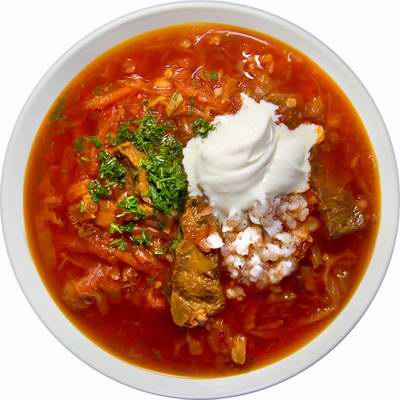
Soups are very popular to start a meal, but I haven't yet been fed soup, even the heartiest of borsch, as a meal by itself. Borsch is something you've most likely heard of- it's a kind of vegetable soup that has as many different varieties as cooks, but it's basically beets, tomatoes, potatoes, and pork or beef topped with dill and plenty of sour cream to give it a pinkish color. The first time I ate borsch I had to force it down, then a few hours later I found myself wanting more, I think that's part of getting used to new foods, you just have to take it slow. Now I absolutely love borsch, I would eat it everyday!
Cold soups are also a thing, but mostly seem to be cabbage and sour milk based and are really only eaten in the summer so I'm holding off on that as long as I can...


Russians don't typically eat salads like Americans do. In the States we generally get a salad of lettuce and other raw vegetables topped with dressing before or accompanying a meal. Here, the word "salat" has a few different meanings. First, it's the word for lettuce, which is confusing as all get out-
-What do you like in your salat?
-Salat.
Salat also refers to both more American-style raw veggie mixes and Russian style mayo-festivals. Russian salat olivier and stolichniy salat are both very popular, especially on holidays, and basically consist of mayonnaise, tiny chopped up vegetables, peas, little ham cubes, and of course dill. Some people find this delicious. Not me.
Stolichniy Salat

Russians really love their bread. Pretty much all meals are accompanied by bread, and not some delicious warm flaky rolls or a garlic smothered baguette, but room temperature sandwich bread without butter or anything. I guess you're supposed to dip it in soup and bite into it after vodka and so on but while it's not unappetizing, I don't really find it necessary- this gets me a lot of strange looks.
There are two types of bread- black and white. Black bread is really hearty, thick, and made with rye, and white bread can range from Wonder Bread to whole grain. Generally the bread is oddly small, in the US when I buy sandwich bread it's about 8" tall (this definitely exists here, it's just not that popular) and bread here is usually only 3" or so.

There are lots of types of meat available- beef, pork, chicken, fish, shrimp, rabbit (NO). Generally I've noticed that meat seems to be kind of thrown into a meal just because. I guess as a source of protein, which is great, but it's never really cooked to intentionally highlight the flavors or whatever chefs do. I think availability of good cuts of meat is not great here (people often drive across the border to Finland to buy fish). Kotletti (cutlets) are popular, I think they're kind of flattened balls of ground chicken and spices- sounds better than it actually tastes.

Sweet stuff: my favorite! Russians are really excellent at pastries. There is a perfect balance between savory/bready/cheesy and sugary that creates the most satisfying desserts! Homeade or storebought, piorzhki (little pies) are delicious- they are generally thick bread shaped like a football and filled with either savory fillings like cabbage, eggs, and potatoes or sweet fillings like cherries and tvorog.
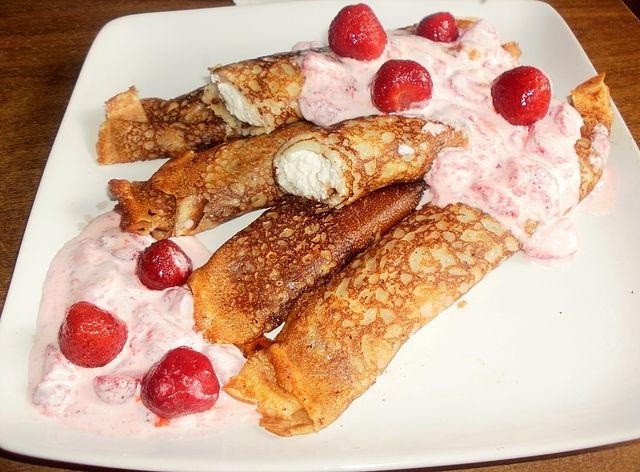
Blini rolled up with tvorog and berries!
Tvorog: the lost dairy product of the east. I am obsessed with this stuff! It's somewhere between cottage cheese and quark (so I've read- never actually tried either of those). It can be mixed with raisins and used to fill or top pastries as a sweet treat or mixed with garlic and dill as a tangy dip or spread.
Another sweet favorite are blini. This is the one Russian dish I've ever attempted making and although I am a disaster in the kitchen, these are so easy I get it right probably 70% of the time! Kind of like crepes, blini are very thin pan-cooked dough circles. You can eat them with gooey, sweet condensed milk, tvorog and fruit, nutella, peanut butter (really hard to find in Russia) and bananas, or anything else you want! I suggest making a big batch because you're going to want to eat about 10.
Ice cream is worth noting because in addition to all the regular flavors, a Soviet-era nostalgic favorite is plombir. "Regular" or "milk" flavored is how it's often described, very mildly sweet and creamy.


When it comes to drinks Russia has it down (although Azerbaijan set a really high bar). Alcohol: well, yes, the rumors are true, Russians love to drink! Not everyone drinks vodka almost every night, but my host mom does, and most people enjoy vodka much more frequently than in the US, where I think adults whose goal is not to get drunk will generally prefer wine or beer on a week night at home. "Napitki" (drinks) are varied here. Every type of soda you could want, Georgian "dushes" (pear soda so delicious when it's fresh), flat and sparkling water in abundance, "tarxhun" (some kind of grassy green soda that I can't stand), aloe vera juice, kvass (slightly alcoholic fermented bread juice that most Russians really love) and anything else you can think of!
Of course tea is extremely popular. I hear "chai budesh'?" (will you have tea?) several times a day- with breakfast and after dinner usually. Tea is more popular than coffee I think. It's not some fancy eastern style tea, generally it's just Lipton tea bags with some sugar and lemon, but I've really grown attached!
If you plan on visiting Russia, though, note that there is rarely, if ever, free water in restaurants. Drinks are expensive and come in tiny glasses with no free refills, so drink sparingly!

Anyway, I know I left a ton of really great Russian foods out, so if you come across something interesting, feel free to ask me what I think of it or encourage me to try it if I haven't yet!
Please tell me your thoughts, I look forward to hearing from you!


Monday, January 27, 2014

The 70th Anniversary of the Liberation of Leningrad

I was going to write a blog about Russian food, but I think taking a moment to acknowledge the significance of today is important. My next post will be a little more fun, I promise!

Today, Jan 27 2014, was the 70th anniversary of the end of the Siege of Leningrad. During the Great Patriotic War (WWII) German forces cut off the Soviet city of Leningrad (now Saint Petersburg) from the rest of the country with intense bombing raids and tank roadblocks. The siege lasted for 872 days: from September 8 1941, until 27 January 1944. Estimates vary, but over a million civilians and soldiers died during the blockade- many of starvation.
For more details on the incredible and important history:
http://www.youtube.com/watch?v=01H3dq7y1Kg
http://www.sptimes.ru/story/38929?page=1#top


I spent the weekend with Roman in Kronstadt, very calm, quiet, and relaxing. I went ice skating outside for the first time and ate delicious homemade pirozhki and sirniki (don't worry, my next post will be food)! 

This morning Roman drove me back to the city center, and right on my street there was a large outdoor display set up as a temporary museum for the Siege/Blockade of Leningrad! (Have I mentioned I live in the best location ever??) We walked around the display for a while, very neat. There were lots of old vehicles from the blockade- trolleybuses, military trucks, even a fire truck! They also had a video screen playing a short film about the blockade, announcements from a loud speaker taken from actual public broadcasts that played during the blockade, posters and flyers set up like 1942 to create the atmosphere of the time, and a wall of one building was converted into a poster board with texts and pictures explaining Leningrad's role in WWII.


Anti-tank Device


I had read that at 7:00 there would be a candlelight procession down Nevsky Prospekt from the outdoor display near my apartment building to Palace Square. So later that night I put on my warmest (read: most American) clothes and ventured outside again. At this point it was snowing lightly, really beautiful as the sun had mostly set and the streetlamps and shop windows were really the only illumination- until I got to Nevsky. Of course, there were plenty of cars, but also hundreds of candles! I smelled them first, the pleasant burning scent, and then slowly noticed all the dots of flame twinkling across the crowd gathered on the sidewalk. I expected that stretch of Nevsky Prospekt to be closed down for the procession- the idea was 1,944 volunteers (the year the siege ended) would march to Palace Square, and there form a human sign spelling out "900 Days" (for the length of the blockade).

Streets were back to 1944

I waited in a crowd of people where I read the procession would start. A blockade-era trolleybus idled on the street, its loudspeaker played Soviet war songs and announcements. Exactly at 7:00PM the speakers blared "NOW, A MINUTE OF SILENCE". Nevsky Prospekt froze. Not just the people clearly involved, holding candles, but mothers pushing babies in strollers, people walking home from the grocery store, young children, as far as I could see there was barely any movement or speech. The trolleybus ticked off the sound of the famous Leningrad metronome (during the Blockade music was broadcast over the Leningrad radio 24/7. At rare times when music was not broadcast, a metronome was placed before the radio microphone to assure the people that the resistance was ongoing) for one minute, as we all let the weight of the anniversary really sink in. Abruptly, the trolleybus began to play music again and people scattered in all directions. Did I miss the parade? I stood in my spot for a moment, craning my neck up and down the street searching for any banners or flags. I wasn't even positive which direction Palace Square was in...but the people with the candles were surging to the right, so I tentatively followed them.


About five minutes later, I realized that I was, in fact, IN the procession. I'm still not sure if there was a more formal procession, but there were news cameras set up all along the route, interviewing people, and people hanging out of windows above us taking pictures. I embraced my new found membership and committed to march the 30 minutes to Palace Square. Even though I didn't have a candle, it was impossible not to feel a heaviness and solemnity being part of such an important remembrance. Every person over the age of 70 is a possible survivor, most of these people's parents or grandparents were in the blockade...and I am a lone American girl, a tourist, trying to adopt a city I have no right to call my own. Perhaps after today I've gotten a little closer to earning that right.

A stop on the route where people placed flowers and lit candles

The events at Palace Sqaure were wonderful. Unfortunately my camera died, but I am a better writer than photographer anyway! All the streetlights and windows were dark in the square, giving the effect of the blockaded city at night, cloaking itself from Nazi bombers. There was a semi-circle of antique military vehicles on the far side and several stages set up in the center. I watched a teen pop quintet sing about the beauty of "our Saint Petersburg, dear Leningrad" and a man sing "we're with you, the people of Leningrad/ we know what war means" (excellent song and lyrics). Then a loud siren sounded and the entire 100-foot side of a neoclassical 18th century building lit up with a projected short documentary about the blockade with video footage and pictures from the war. After the film, another parade entered. All the vehicles from the outdoor display near my apartment rolled into Palace Square! People were cheering and throwing roses into the truck beds; it was all very moving.

It was past 8 when I finally looked down at my watch and speed walked home for dinner. I hadn't noticed the cold much before, but it was -16 Celsius with a sharp wind and by the time I got inside my face was bright red and I could hardly feel my fingers and toes! Dinner was delicious, smoked red fish (my favorite) and tomato and avocado salad with black bread and beans. Since it was a prazdnik (holiday), of course we had to drink vodka as well! Then after dinner there were fireworks I watched from my window, perfect way to end an incredible day.

I learned so much about the Siege of Leningrad today and how even 70 years later it is still a deep part of the consciousness and identity of the people of the hero-city of Leningrad. I hope this little blog post recognized the event as it deserves and piques your interest to learn more about the Eastern front of World War II!

Monday, January 20, 2014

Welcome to Russia! "Because God loves 3..."

So I made it! I am officially in Russia, settling into my new apartment, and beginning to acclimate to my new life. The journey here had some dramatic points so I'll start from the beginning:

So I'll just come out and say it: I suck at packing. I have never gotten it right, even for just weekend trips I struggle! My only excuse here is that I've never had to pack for this long (7.5 months) or this many weather conditions (I'm here for the coldest and warmest parts of the year, lots of ice, snow, and rain). I've also never been compelled to bring school supplies- such as my 2 lb (we weighed it) Russian grammar book.
Yes, yes, I'm basically packed! I affirmed to everyone who asked, which was everyone I talked to for days before I left. And I basically was...I had just hit a natural stopping point as my two suitcases were teetering on the 50 lb mark so I stopped. I left all the rest of the things I wanted to bring in a pile mentally marked for my carry on bag and purse and went to watch movies and do henna with my sister. Then it was midnight the night before I leave, fresh claws (acrylic nails) on, wet henna on my hand, and my left wrist and hand mysteriously bruised, and the struggle begins. I stayed up until 3 am trying to shove everything into my frame pack with one hand, but I was still left with a sizable pile of things I needed but just couldn't fit. Thank goodness for my mom who swooped in and saved the day at 5 am. When I was barely awake, running on the fumes of the adrenaline of fear, she solved my packing woes and got us on the road. 90% of the way to DC we panic, bags are definitely too overweight, so we stopped at Macy's and bought a new suitcase that was lighter and repacked everything in the airport parking lot. Unfortunately, they were still overweight...I ended up (of course) reorganizing and cutting the fat from my luggage on the floor in front of the United check in desk less than an hour before my flight to Chicago left- but we managed it! I had to ditch my gummy vitamins (1 lb), grammar book (2 lb), one of my coats (2.5 lb), and a few other things but I kept all of the essentials. With my 10 lb 'purse' and 35 lb carry on with a broken wheel we said our goodbyes and I hobbled through security.

DCA-->ORD-->ARN-->LED 
I made it all the way without the wheel on my carry on popping off completely!

The flight from Stockholm to St Petersburg, let me tell you, scariest of my life...I don't want to freak my dad out so I won't go into too much detail haha but word for the wise: Rossiya is not your friend

Passport Control: The flight before ours was from Kyrgyzstan and of course I get in the shortest line, but I ended up behind about 20 Kyrgyz men, women, and teenagers immigrating to Russia on work visas. Russia has somewhat of an issue with illegal immigration from Central Asia so they checked each person's documents for 5+ minutes and a few even got asked to step aside...uh oh
Anyway, this made me on of the the last people to come through to get my luggage and the whole hall was nearly empty. I had 2 giant bags plus my carry ons so I grabbed a cart and was moving pretty slow and awkwardly. I've been to Russia three times but for the life of me I could not remember if I needed to fill out a customs form even if I wasn't declaring anything! (You have to when you enter the US). I hesitated at the customs gate- terrible mistake. The customs agents (read: evil witches) swooped in! "Passport...Amerikan? Ah, ah, yisss, Amerikan, pleez put bags here"
So I unloaded my cart, sent all my bags through the scanner, and then weighed them...APPARENTLY there is some random customs law saying if you bring more than 50 kg of stuff into the country you have to pay a fee. And APPARENTLY the customs witches decided the fee for the American girl would be 4 Euros per kilo over...that would run me about 70 Euros...aw hell no.
So of course I start arguing with them, but my Russian polite argument vocabulary is sub par so I resorted to stomping around the empty baggage claim hall, shaking my head, and saying Russian phrases like "No, I cannot, I am a student, I have no money, WHY IS THERE A CAT INSIDE THE AIRPORT?? (there seriously was...)"
Thank God Roman turned up then, and the customs witches let him in to translate for me. After about 30 more minutes of angry glares and several incorrectly filled out customs forms Roman was able to talk to the manager who told us that rule doesn't even apply if the belongings are in the country temporarily and for personal use only- well THANK YOU!
So I was let out of airport jail (okay, it was just an old desk in the corner, but it was demeaning) and we finally made it to Roman's house.

After a few blissful days of being fed by Roman's mom, we hauled my bags back into the car and to my host mom's apartment in the city center. When I say city center, I mean it. I haven't taken any pictures myself yet, but this is literally steps from my building:

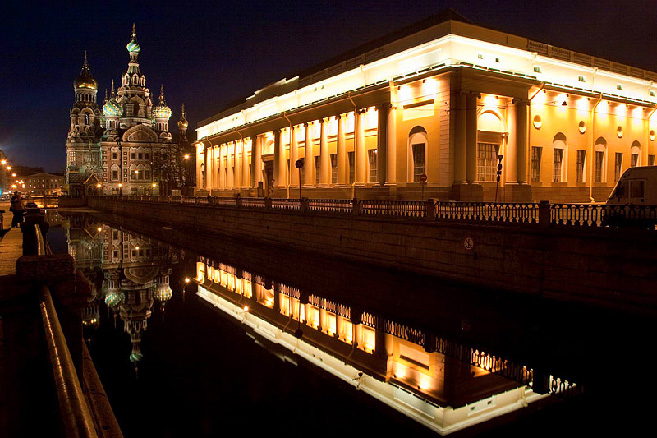
Russian Museum, Church of the Savior on Blood, Griboedov Canal 

 And I am just around the corner from the beautiful Kazan Cathedral and my university!

Kazan Cathedral
Saint Petersburg State University of Finance and Economics

My host is an older, single woman who is a retired TV editor. I don't quite have the language skills to ask her how she came into this apartment, but this location, the size and amenities (3 bed, 1.5 bath, large kitchen, newly renovated, courtyard with a gate), I think an apartment like this is generally held by very influential or wealthy people. Her name is Tatiana, she has been very kind and welcoming to me. Not exactly the warm mama-bear type, but she has been chatty, interested in me and my life, and very accommodating. My room is huge! Plenty of room for all my stuff (I definitely don't think I overpacked, but I guess we'll have to wait and see what I actually wear/use). I have a double bed; in typical Russian style it is a fold out couch-bed. Not like the pull out beds we have in America, but basically the back of the couch just folds down so the whole thing is flat...and this one is particularly hard. I can't complain, though, it's probably as comfortable as my bed at school!
I will be doing breakfast and lunch on my own, but she makes me dinner. She said right off the bat she's not a cook, and after Roman's mom (she trained as a chef) I guess I have kind of high standards, but dinner wasn't bad! Rice, chicken balls in kind of a cream-breading, black bread, salad, and....forest mushrooms. Yes, that's right. Little brown fungi whose last meal was probably a human head in a glass mason jar suspended in about 3 inches of clear slime. She presented them to me with such excitement, such gusto, picked by a friend of hers in the fall, she said...I couldn't say no. She spooned a dollop of slime and shrooms onto my plate, they oozed across the surface, a string of slime stretching gracefully across the table. I almost couldn't do it...but I did. I buried those little suckers in the chicken balls and swallowed barely chewing. They really didn't taste as putrid as I expected, but I am not eager to repeat that experience anytime soon.
I think it was these little suckers

The other interesting aspect of last night's meal was the vodka! A little more familiar to me than slime fungus, but I wasn't expecting it. At first I tried to refuse, but she looked so crestfallen that we downed three shots " because God loves three"- one to our relationship, one to the city of Saint Petersburg, and one to my future as a diplomat  =)

We don't have wifi installed in the apartment yet (apparently it's coming today but I'm not overly optimistic), so I've walked about 10 minutes to a coffee shop with free Internet. To my right is Kazan Cathedral, dusted with snow, and the famous Nevsky Prospekt is at my back. I ordered a hot chocolate with whipped cream and the descriptions are really true, Russian горячий шоколад (goryachii shokolad) is "thick as mud". It tastes sort of like Hershey's chocolate syrup heated up. It comes in a tiny little tea cup, but it's so rich that's really all you need!

Now I am going to attempt to run some errands. This city is so saturated with shops and restaurants I've barely walked anywhere and I'm already overwhelmed! Wish me luck, my 10 readers, and please comment on the post! And if you made it this far, thanks for your time  ;)


Friday, January 17, 2014

Ateshgah


Stories from the Land of Fire: 1

Originally published on http://karabakhfoundation.com/heritage-center-online/blog/


This past summer I was selected, along with nine other American students, as a winner of a national essay contest sponsored by the Azerbaijan Ministry of Youth and Sport and received a twelve day, all expenses paid trip to Azerbaijan. I would like to share my wonderful good fortune and help those who have not yet visited the incredible country to understand life there little bit better, but as there are already a few posts on the subject, I will refer you to “Impressions of an American High Schoolstudent in Baku” by Matthew Miller and “An Azerbaijani American in Baku” by Farzin Farzad for an overview on the subject. Instead, I will share with you a few stories from my trip that I think offer some insight into the untamed mystery and boundless intrigue that I experienced over my two weeks in Azerbaijan. 
Ateshgah

Azerbaijan- Land of Fire, right? The epithet is frequently used in tourism ad campaigns and YouTube videos, but many people are unfamiliar with its roots. The name Azerbaijan is thought to be derived from ancient Persian meaning guardian/protector of fire. Fire has long held a central place in Azerbaijan’s culture due to the naturally occurring flames in some areas caused by powerful underground gas vents. The ancient people of Greater Iran followed the Zoroastrian faith and worshiped the natural fires of Azerbaijan going back as far as the first millennium BC. Zoroastrianism is a fascinating practice, and Azerbaijan is often quickly associated with it in light conversation, but I really did not know much about the religion and its ties to the country until I visited Ateshgah Fire Temple in Baku. The temple itself has been mostly rebuilt as a replica of the original, a slightly disappointing trend I saw in a large number of exhibits in the country, but was still an imposing structure. It had lots of open spaces, arches, and fortification-like walls. Mannequins of ancient fire worshiping pilgrims (kind of creepy, to be honest) were set up in some of the rooms built into the temple’s walls. Manmade gas-lit fires were also laid out where natural fires once burned in order to give visitors a picture of the temple when it was active.


What really struck me about the temple was that it was abandoned so recently, in 1883, after an earthquake snuffed the natural fires which the Zoroastrians took as a sign that their god’s favor had turned against the spot. While America was fighting its Civil War, fire was being worshiped as a divine revelation on the oh-so-remote Absheron Peninsula. The word “ancient” always seems to be used in discussions of Zoroastrianism in Azerbaijan, but in fact the traditions there died out not so long ago. Another interesting fact I learned is that Zoroastrians were vegetarians! Instead of sacrificing animals they sacrificed fruits, with the pomegranate being the most holy as its deep red and spiked crown are reminiscent of flame. 
A few of us took the opportunity to create a little Nowruz celebration. Nowruz is an extremely popular holiday in Azerbaijan that is derived from Zoroastrian traditions. The holiday celebrates the coming of spring and traditionally, as a recognition of Nowruz’ fire-worshipping past, every Tuesday for four weeks prior to the holiday children jump over small bonfires and candles are lit. So we picked the biggest bonfire, blazing in the center of the temple, joined hands, and, channeling through us the centuries of tradition and faith in the Caucasus, Azerbaijan, Baku, and this very temple, leaped over the flames.